
Three items surfaced recently in the media with relation to the Big Ten. One item, that Michigan State would be in the East division when Maryland and Rutgers join in 2014; second, that B1G baseball should start later because of the weather; and, the other item, is the recent article in Sports Illustrated with interesting comments by Commissioner Jim Delany. Let's get into football divisions first.
MSU in the East
So, if Michigan State were to join an East division as has been recently reported, their climb to the Big Ten championship game in football every year would likely need to include two victories against division foes Michigan, Ohio State, and Penn State in addition to wins over bottom feeders Maryland, Rutgers, and Indiana. So, out of the six divisional opponents each year, it seems reasonable that it will take five victories in the “three yards and a cloud of dust” division to be in contention. With nine conference games every year, that leaves three games against opponents from the Western division; winning at least two of those would lead to a 7-2 conference record, which seems to be a reasonable minimum to advance to the conference championship game.
Now, the Big Ten has also agreed to eliminate scheduling of patsies, like Appalachian State, Youngstown State, Northern Colorado, Northern Iowa, or other Division I–FCS football programs. This is a good thing, in that the strength of schedule for the Big Ten and particularly for Big Ten East division members, should be strong enough for the Big Ten championship game winner out of the East division to also be considered for the new BCS football playoff. In other words, an 11-2 Michigan State Big Ten championship team with division wins over Michigan, Penn State, and other conference wins against Wisconsin or Nebraska, and nonconference wins against future opponents Notre Dame, West Virginia, and/or another strong BCS qualifying institution will be received favorably by a playoff selection committee. Of course, this means that the Spartans need to clean house in the conference with maybe an occasional loss at Ohio State, at Wisconsin, or at Nebraska… But the nonconference games need to be victories for the most part, with the exception of maybe playing at Alabama or at Oregon -- these strong national title contending institutions will add to the value of the Spartans resume even with a loss. I think we all know, however, that the road to the Big Ten championship will go through Columbus and that's a tough task indeed.
Tim Stout and Big Ten baseball
The Dean of mid-Michigan sports, Tim Stout of WILX-TV, recently wrote in the Lansing State Journal that if the Big Ten is going to expand baseball stadiums, institutions should consider moving its baseball calendar a month or so later because of the poor weather in March/April in Big Ten country. He specifically noted how Wisconsin does not have a baseball team. Let's be honest, Wisconsin here is the only smart institution with respect to understanding what it can provide as reasonable opportunities for sport participation in the area. We can't looking at this through a competitive lens as opposed to understanding who it is that is participating. Big Ten baseball players are college students; most colleges are on semester systems, which would mean shifting the calendar would impact athletes across two semesters (or more, as some baseball manages to fit in exhibition in the fall) and into the dog days of summer. Already, college students are being asked enough with respect to time management and progress to graduation…. The ES just doesn't buy the fact that shifting the calendar would not have a detrimental impact more so than is already the case on these players. So his point of "lack of common sense" of the current calendar or plowing resources into baseball makes sense. Moving the calendar would serve for entertainment purposes, improving attendance at games, and actually may make it a more enjoyable experience for the players. Really, who wants to catch a fly ball between snowflakes anyways? BUT, let's base any principle to make the decision on what's in the best interest to help these college students learn.. and NOT on entertainment and enjoyment of the game. Athletics should be a co-curricular activity, and not the primary activity.
So, I think that Wisconsin actually has it right. I never understood why Michigan State would want to enhance its baseball stadium, when it is already under snow three-fourths of the year. That is a waste of 5 million VERY good dollars that could be used instead for other purposes. If anything, Big Ten schools should eliminate baseball so they can save other sports which are more reasonable to participate over the winter months. My God, it's nearly April and we still have snow on the ground and it's 32° outside… Is there not a sense of reason? Baseball in the North makes as much sense as ice hockey in the South… College athletic programs should not have to be all things to all people, but rather focus on quality instead of quantity. Follow Wisconsin's lead: eliminate baseball and invest in winter sports.
Delusional Delany?
Lots of interesting tidbits coming out of the Big Ten office in the last week. If you are not aware of the Eddie O’Bannon lawsuit, you better be aware now. The lawsuit contends that the NCAA unlawfully used the likeness and image of college athletes in its own marketing efforts, as well as selling those rights to companies without providing just compensation to the athletes. It is complicated when you think of: how Title IX requires institutions to provide equal opportunities to all athletes male and female; that funding and resources be equitable for male and female athletes; how scholarships and other benefits are worth tens of thousands of dollars every year and are tax-free; that athletes would be taxed if they did receive compensation for selling their image for publicity; and, that athletic conferences, colleges, and the NCAA make billions of dollars each year from selling rights to broadcast football and men's basketball on television. Regardless, there are many who believe that O’Bannon has a good case and may likely be victorious (here, here, here, here, etc). When you think of the NCAA budget being about $800 million a year, this case may bankrupt the NCAA if the courts allow it to be certified as class action for athletes going back 50 years. Yes, college sports could change as we know it.
So Jim Delany's comments in Sports Illustrated certainly were interesting if not telling. Delany notes that if the Big Ten is required to pay players or subsidized payment for the lawsuits because players no longer are amateurs but rather need to receive compensation for their success on the field above and beyond his scholarship, that the Big Ten may instead give up Division I sports and become Division III institutions, or follow the idea and not give scholarships. Some see this as Delany blowing steam under the robes of justices to let them know that their decision may be of significant consequence to the current model of college sports; in other words, if justices like watching how their alma mater competes in football or basketball on tv, Delaney muses they may want to think twice about how they will decide in this lawsuit. However others see Delany as being two-faced, in that now he's going to whine and take his ball and go home because he no longer can control how money is being distributed.
Bottom line is, Delaney is giving us lots to think about, and all of you college sports fans out there better start paying attention. Delany is paying attention, but he doesn't seem to have very good answers right now.
Showing posts with label Big Ten divisions. Show all posts
Showing posts with label Big Ten divisions. Show all posts
Tuesday, March 26, 2013
Saturday, February 23, 2013
B1G cans Legends-Leaders for East-West, Mark Emmert on the coals
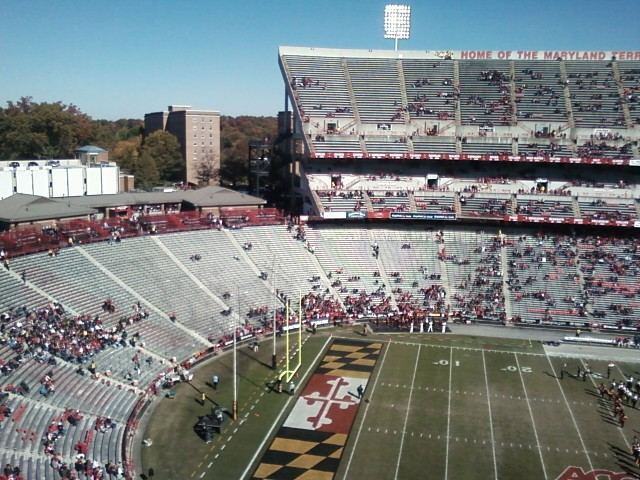 So after watching the Big Ten network the other day and
listening to the comments from Ohio State athletic director Gene Smith, it seems
reasonable to expect that Ohio State and Michigan
will be in the same division when the Big Ten reforms its lineups upon the
arrival of Maryland (lovely football attendance example at right) and Rutgers.
I really do believe that there will be an East and West division, and the
Spartans will likely end up in the West division. Here is what it would look
like:
So after watching the Big Ten network the other day and
listening to the comments from Ohio State athletic director Gene Smith, it seems
reasonable to expect that Ohio State and Michigan
will be in the same division when the Big Ten reforms its lineups upon the
arrival of Maryland (lovely football attendance example at right) and Rutgers.
I really do believe that there will be an East and West division, and the
Spartans will likely end up in the West division. Here is what it would look
like:
East: Maryland, Rutgers, Ohio State, Michigan, Penn State, Purdue, Indiana
West: Michigan State, Northwestern, Illinois,
Iowa, Nebraska,
Wisconsin, Minnesota
ES made a brief shout out to the Huge Show the other day in
response to his question of whether Michigan
State should be in the same division
as Michigan.
Let's get real, as Spartan fans we really don't care because this will be a
protected rivalry and the Spartans still will always play Michigan in the same year... always giving us a
chance to kick their tail.
Stealing from the ACC to grow B1Gger
Talking is growing lowder about adding more schools to the Big Ten conference. Schools that are mentioned the most as potential additions include Virginia, North Carolina, and Syracuse. Yes, these are all Atlantic Coast conference ACC schools and while the ACC does have a media contract worth $13 million dollars per school, it does not rival the Big Tennetwork and the Big Ten's media contracts which at last estimate was worth $19.3 million per year per institution and with a renegotiation from the addition of Maryland and Rutgers, it is expected to be worth as much as $27 million per year beginning in 2014. Reaching South from the New York and DC markets to cherry pick Virginia and North Carolina two the Big Ten makes sense from an expansion standpoint with the alignment of two additional high-profile academic institutions, competitive football and basketball programs, competitive nonrevenue sports such as soccer, lacrosse, golf, tennis, and track and field. Adding these two schools also will further enhancing the value of the Big Ten Network. Charlottesville Virginia is a DC Richmond constituency, while North Carolina has the Raleigh, Durham, Winston-Salem research triangle, as well as potentially the Charlotte area. Adding an additional 10-15 million viewers to the network would further raise the value of the Big Ten network to maybe 32 or $35 million annually.
Talking is growing lowder about adding more schools to the Big Ten conference. Schools that are mentioned the most as potential additions include Virginia, North Carolina, and Syracuse. Yes, these are all Atlantic Coast conference ACC schools and while the ACC does have a media contract worth $13 million dollars per school, it does not rival the Big Tennetwork and the Big Ten's media contracts which at last estimate was worth $19.3 million per year per institution and with a renegotiation from the addition of Maryland and Rutgers, it is expected to be worth as much as $27 million per year beginning in 2014. Reaching South from the New York and DC markets to cherry pick Virginia and North Carolina two the Big Ten makes sense from an expansion standpoint with the alignment of two additional high-profile academic institutions, competitive football and basketball programs, competitive nonrevenue sports such as soccer, lacrosse, golf, tennis, and track and field. Adding these two schools also will further enhancing the value of the Big Ten Network. Charlottesville Virginia is a DC Richmond constituency, while North Carolina has the Raleigh, Durham, Winston-Salem research triangle, as well as potentially the Charlotte area. Adding an additional 10-15 million viewers to the network would further raise the value of the Big Ten network to maybe 32 or $35 million annually.
Emmert is walking wounded

The state of Pennsylvania's suit against the NCAA does seem to have merits as Penn State was not given an opportunity for due process. At Miami, the fact that Emmert fired his vice president for enforcement because of “improper investigation techniques”seems to fly in the face from what his own staff and other former investigators seem to believe are consistent with previous investigations. Either Emmert doesn't know what's going on, or he has extremely bad public relations and should learn to keep his mouth shut instead of grandstanding his academic virtues.
 Indeed, when one considers these
scandals and how the NCAA's own academic performance measurements are watered
down in favor of eligibility, one has to wonder why he is even grandstanding.
Furthermore, on the horizon lies that Eddie O'Bannon's lawsuit, which most experts agree has the potential to be a
complete game changer for the future of college sports as we know it. If the
NCAA loses the suit, potentially hundreds of millions or billions of dollars
may have to be paid to former college athletes because the NCAA licensed their
image for video games commercials and other purposes without asking the
athletes specifically. Considering that the NCAA only makes $750 million a
year, the institution could go bankrupt. If the NCAA wins the lawsuit, the
argument has already been presented and the NCAA will need to respond to public
and education demands of what the real role of major college football and
basketball is for our nation's colleges.
Indeed, when one considers these
scandals and how the NCAA's own academic performance measurements are watered
down in favor of eligibility, one has to wonder why he is even grandstanding.
Furthermore, on the horizon lies that Eddie O'Bannon's lawsuit, which most experts agree has the potential to be a
complete game changer for the future of college sports as we know it. If the
NCAA loses the suit, potentially hundreds of millions or billions of dollars
may have to be paid to former college athletes because the NCAA licensed their
image for video games commercials and other purposes without asking the
athletes specifically. Considering that the NCAA only makes $750 million a
year, the institution could go bankrupt. If the NCAA wins the lawsuit, the
argument has already been presented and the NCAA will need to respond to public
and education demands of what the real role of major college football and
basketball is for our nation's colleges.In all honesty, the ES just don't see Emmert as being the right guy to answer that question nor lead an organization in response to the lawsuit and likely respond to public indictment regardless of who ends up on the victorious side of the suit.
Monday, January 14, 2013
Big Ten Approves New Divisions for 2014: Inactive and Not Alert

What was most surprising are the top names for his consideration: "The fact of it is we were 'inactive' and 'not alert' for 22 years as we had 11 members."
Wow, so what would make an "Inactive" division and a "Not Alert" division? There's a shock. Let's see:
INACTIVE:
Indiana - Permanently inactive in football.
Maryland - By time they start in the fall, spring sports still won't be active.
Nebraska - Permanently inactive in basketball.
Ohio State - Cheaters on probation for this, that, or tattoos depending on the year.
Penn State - Inactive in football until 2017-2018.
Rutgers - See Maryland.
Wisconsin - Bielema was never alert, but FB is in question-mark mode.
NOT ALERT
Iowa - Ferentz dropped his guard on football to rise of MSU via Dantonio.
Illinois - Got Zookified for 5 years in football and fired a great hoops coach in Weber.
Michigan State - Spartans go 7-6 and have an 0-fer in Big Ten FB at home in '12.
Michigan - Still crawling back from the depths of football and basketball hell.
Minnesota - Building a beautiful new football stadium where it is cold as ice.
Northwestern - Stealing Carmody from Princeton was brilliant; yet NW still has never been to NCAA's in hoops.
Purdue - The Boilermakers' impatience with Hope makes the ES scratch his head with what Purdue is (between Indianapolis and Chicago) and what it thnks it is (????, still trying to figure that out).
Monday, December 13, 2010
MSU a Legend; Big 10 now called B1G
 OK. Announcement out of Big Ten HQ today... The ES likes the division names, hate the new, UNC Powder Blue colored logo. B1G is clever but the font is sinful. But who cares really? The Legends Division is a brutal football division, while the Leaders Division looks to have a stronger men's hoops base.
LEGENDS: Iowa, Michigan, Michigan State, Minnesota, Nebraska, Northwestern
LEADERS: Illinois, Indiana, Ohio State, Penn State, Purdue, Wisconsin.
Let's get real. Why don't we change the name to the Big Twelve?
Bowl Preview: ESPN picks Alabama over Michigan State
ESPN had its bowl preview last night, with pundits (Robert Smith, Todd McShay, some other punk) giving 19, 25, and 29 confidence points to Alabama to win over Michigan State. Fine. But what was wrong with the presentation? It only discussed Alabama, had nothing to say about the Big Green. Sigh. We still have a ways to go for respect, Spartan fans...

Friday, September 03, 2010
New Big Ten Divisions includes Nebraska with MSU
Fastforward 2011: ES really likes being in the same division as Nebraska and playing them every year. Sure, we've never beating the Corn, but having the chance to play a storied program every year is awesome.
The divisions are:
1) Iowa, Michigan, Michigan State, Minnesota, Nebraska and Northwestern
2) Illinois, Indiana, Ohio State, Penn State, Purdue and Wisconsin
The divisions are:
1) Iowa, Michigan, Michigan State, Minnesota, Nebraska and Northwestern
2) Illinois, Indiana, Ohio State, Penn State, Purdue and Wisconsin
Each school will play the other five schools within its division and will also face three teams from the other division, including one cross-division matchup guaranteed on an annual basis. The guaranteed cross-division matchups are Illinois-Northwestern, Indiana-Michigan State, Ohio State-Michigan, Penn State-Nebraska, Purdue-Iowa and Wisconsin-Minnesota. Names for each Big Ten football division will be announced at a later date.
The winner of each Big Ten division will meet in the inaugural Big Ten Football Championship Game, to be played December 3, 2011, at Lucas Oil Stadium in Indianapolis. The championship game will determine the Big Ten Champion and the conference's participant in the Rose Bowl Game.
Subscribe to:
Posts (Atom)

